Home Loans in Estonia: How Banks Value Your Property
How Estonian banks value mortgage collateral: LTV and down payment rules in plain language, the appraisal's role, and why a data-driven estimate helps first.
On this page7 sections · 5 min read
The bank lends against value, not price
There is one principle in Estonian mortgage lending that surprises many first-time buyers, especially those arriving from other markets: the bank does not size your loan from what you are willing to pay, but from what it believes the collateral is worth.
When the purchase price and the bank-accepted value match, you never notice the difference. But when the appraisal comes in below the purchase price, the bank calculates the loan from the lower number — and the gap comes out of your own pocket. That is why it pays to understand a property's value before making an offer, not during loan processing.
LTV and down payment in plain language
The Bank of Estonia (Eesti Pank) sets binding limits for every bank issuing housing loans in Estonia:
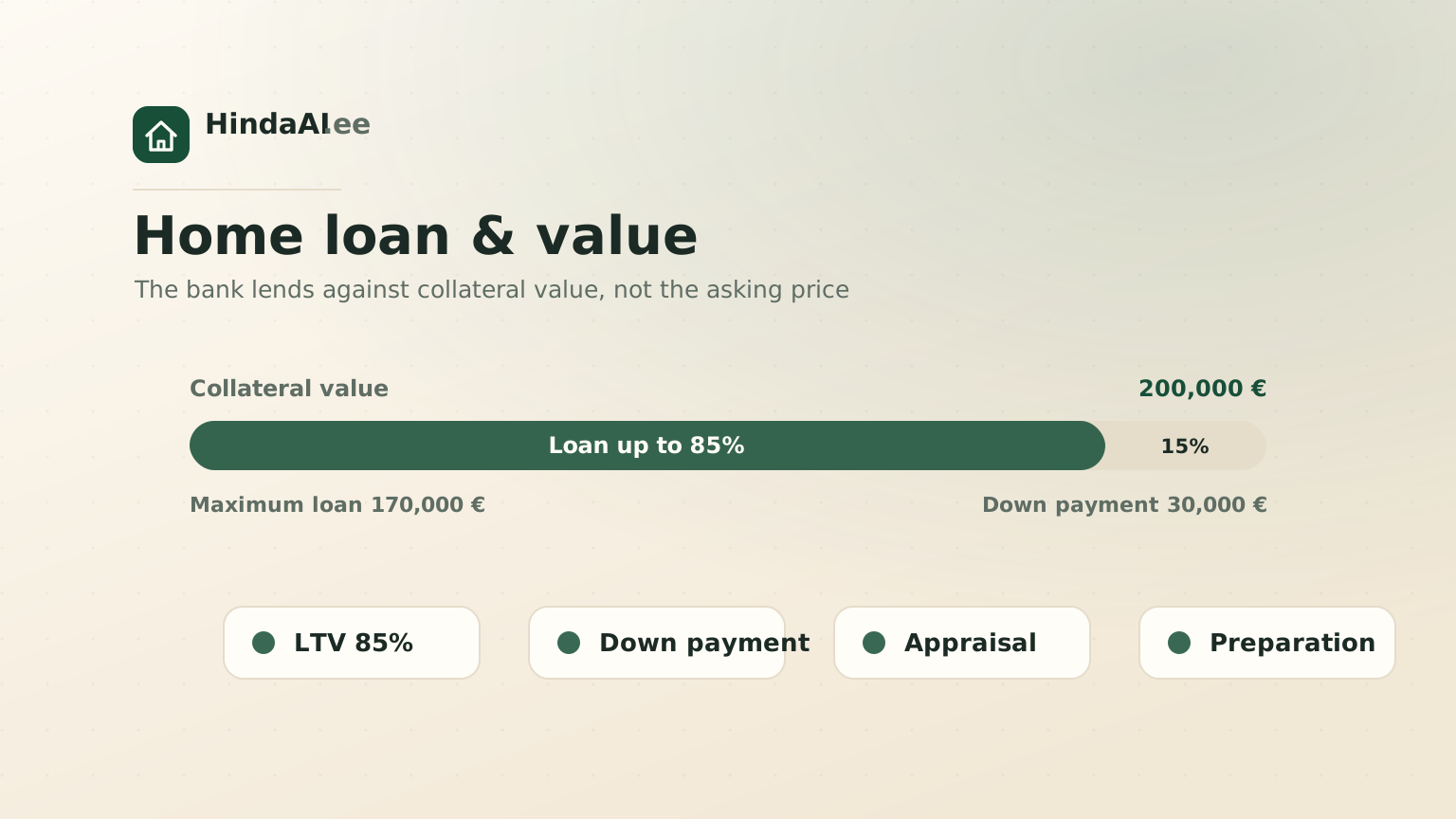
- the loan can be at most 85% of the collateral's value (the LTV, or loan-to-value ratio)
- with a state guarantee, the LTV can reach 90%
- total loan payments must not exceed 50% of net income
- the maximum loan term is 30 years
In practice, an 85% LTV means a down payment (omafinantseering) of at least 15% of the collateral's value. And here is where value becomes personal: the down payment percentage is calculated from the appraised value, not from the purchase price.
A simple example. You buy an apartment for 200,000 euros. If the bank accepts a value of 200,000, the maximum loan is 170,000 and your down payment is 30,000. If the appraisal says 190,000, the maximum loan is 161,500 — and your down payment grows to 38,500 euros, because the price gap is entirely yours to cover.
How the bank arrives at the collateral value
For the bank, the valuation is risk control. Two main routes are used.
A certified appraisal report
For most transactions the bank asks for an appraisal (hindamisakt) prepared by a professional valuer under the Estonian valuation standard EVS 875. Banks accept reports from specific firms — the lists are public on the banks' websites. Depending on the property, a report typically costs a couple of hundred euros, and it is usually ordered and paid for by the loan applicant.
The bank's statistical model
For typical apartments in the larger cities, banks increasingly use their own statistical models, which estimate value from transaction data without a site visit. This makes the process faster and cheaper, but the models are conservative: for an atypical property, an older house, or a smaller town, a full report will still be required.
Either way, the same logic holds: the better the official data on the building and the land matches reality, the smoother the valuation goes. A faulty building register entry or a missing occupancy permit can delay the appraisal or drag the result down.
A data-driven estimate before the bank: why it helps
Getting a data-driven estimate before talking to the bank gives you three practical advantages:
- you know whether the asking price fits market logic at all, before emotion decides
- you can plan your down payment realistically, because you see a value range rather than just the listing number
- you spot the risk points — energy class, building condition, register data errors — before the appraiser or the bank finds them for you
It is important to keep the roles straight: a statistical estimate does not replace the appraisal the bank requires. It is a preparation tool that helps you ask the right questions at the right moment. For a deeper comparison, see our article on data-driven estimates vs certified appraisals.
Refinancing and the home you already own
The same logic works when you already have a loan. If your home's value has grown since the purchase, your LTV may have dropped well below 85% — which opens options: renegotiating your interest margin, moving the loan to another bank, or borrowing against the freed-up collateral value for a renovation.
As a homeowner, it is worth tracking your property's value the same way you track your interest rate. Alongside value, owner costs are shaped by the assessed land value and land tax rules — we have covered those on the land tax page.
Where HindaAI fits in the process
HindaAI gives you the data-driven picture before the official steps start costing money. The free snapshot shows building data, the HindaAI score, risks, and the neighbourhood. The full report (opening soon) ties building register, Maa- ja Ruumiamet, and Statistics Estonia data into one grounded estimate with a range, risk signals, and source references — essentially the same homework the bank and the appraiser will do anyway, but in your hands before the negotiation.
Summary
The size of a home loan starts from the collateral's value: LTV up to 85% (90% with a state guarantee), loan payments up to half of net income, and a term of up to 30 years. The bank hears the value from an appraisal report or a statistical model, not from the listing. Do your homework before the bank: check the official data, look at a data-driven estimate, and plan your down payment from value rather than hope. You will reach the loan decision faster — and without expensive surprises.
Sources
- Bank of Estonia — housing loan requirementseestipank.ee
- LHV home loanlhv.ee
- Valuation firms accepted by SEBseb.ee
- HindaAI methodologyhindaai.ee
Prepared by HindaAI Team · Reviewed by HindaAI Editorial Review · Published July 17, 2026 · Updated July 17, 2026